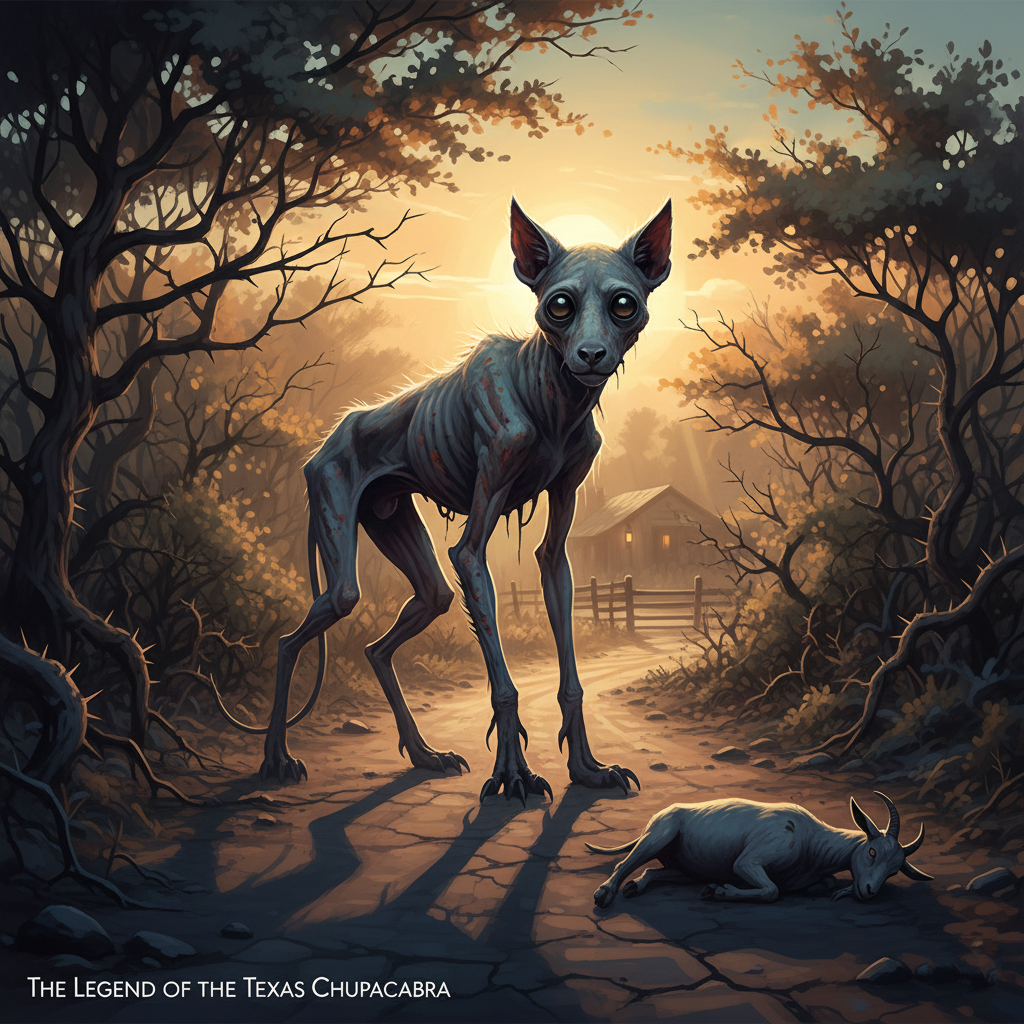
Something is killing the animals in South Texas. Ranchers wake up to find their goats dead in the early morning, their chickens motionless in the yard, their sheep lying where they should not be lying. The bodies show little sign of struggle. The cause of death is difficult to name. And whatever did it is always gone before the sun comes up.
This has been happening for a long time. The name people use for it comes from Spanish. Chupar means to suck. Cabra means goat. Put them together and you have the word that ranchers use to describe something they have never been able to fully see, catch, or explain. The Chupacabra.
What Does It Look Like?
In Texas, people who claim to have seen the creature describe something that sounds more like a diseased coyote than a monster. Hairless skin, grey or blue-grey in color. Large eyes. A hunched, skeletal frame. Claws. A way of moving that is slightly wrong, slightly too fast, slightly too low to the ground. Something that is almost a coyote but is also, somehow, not quite.
Famous Texas Encounters
In 2007, a woman named Phylis Canion lost twenty-six chickens on her ranch near Cuero, Texas. Each bird was found dead with the same kind of wound. When she discovered a strange hairless animal dead on the road outside her property, she had it tested at a university laboratory. The results identified it as a coyote suffering from severe mange, a skin disease that causes complete hair loss and gives affected animals a skeletal, alien appearance. Canion mounted the head and kept it. She did not believe the laboratory results told the whole story. The animal she had found looked nothing like any coyote she had ever seen in forty years of living on that land.
What Do Scientists Say?
Most biologists believe that Chupacabra sightings are coyotes or foxes suffering from sarcoptic mange. Sick animals do look extraordinary when the disease has progressed far enough. And sick animals do attack livestock they would normally avoid, because hunger and pain change behavior. But the stories keep coming. And the animals keep dying. And the thing that is doing it keeps disappearing before anyone can get a clear look at it. In Texas, the line between legend and lived experience has always been a little blurry. The Chupacabra may be the best example of that the state has ever produced.