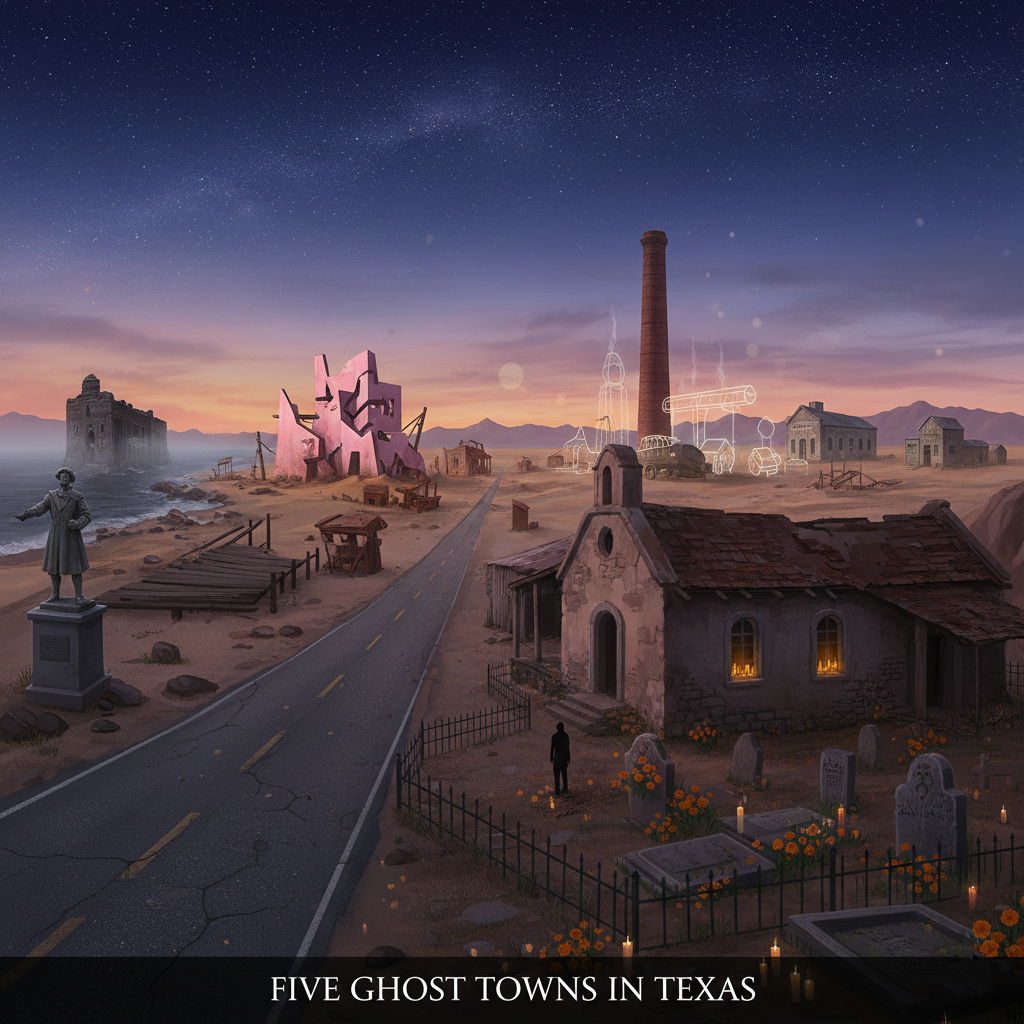
Every town in Texas has a story. But some towns have a story that ended before anyone was ready for it to end. These are not places that were simply forgotten. They are places that once held real families, real futures, real noise and laughter and argument, and then lost everything, sometimes slowly over decades and sometimes in a single catastrophic night.
Terlingua
Terlingua sits near the edge of Big Bend National Park in the far southwest corner of the state, in country so remote that most Texans have never seen it. In the early twentieth century, this was a mercury mining town with thousands of workers. Then the mercury ran out, the company left, the workers followed, and Terlingua grew silent in the particular way that only truly abandoned places ever do. But Terlingua never quite died. A small number of people moved back into the ruins over the decades, building new lives among the crumbling adobe structures. Today it exists in a strange in-between state, part ghost town and part living community. The old cemetery is the heart of it. Local residents still place candles and flowers on the older graves.
Lobo
Lobo is on Highway 90 between Marfa and Van Horn, and if you blink at the wrong moment you will miss it entirely. It was a railroad town once, built because the railroad needed it and abandoned completely when the railroad no longer did. What remains is a handful of crumbling structures and a famous pink building that an artist eventually converted into a roadside installation. The silence there is extraordinary. The desert has been slowly reclaiming the buildings for decades, and standing in the middle of what used to be a functioning street, with nothing but wind and distance in every direction, is a particular kind of feeling hard to find anywhere else.
Indianola
Indianola was once one of the most important ports in Texas, a major entry point for European immigrants in the 1800s. Then two massive hurricanes hit, one in 1875 and another in 1886. The second was so devastating that the survivors simply gave up and walked away. Today nothing remains except a historical marker, a statue of the French explorer René-Robert Cavelier, and the memory of a town that the Gulf of Mexico decided to keep. Fishermen who work the waters near the old site say that on certain quiet evenings, they hear things carried on the wind that they cannot account for.
Mentone
Mentone is the county seat of Loving County, the least populated county in the entire United States, with fewer than a hundred residents spread across more than six hundred square miles of West Texas desert. The town itself has almost nothing in it. A courthouse, a few buildings, a post office. Walking through it feels less like visiting a ghost town and more like arriving somewhere that time genuinely forgot to finish.
Thurber
Thurber was a coal mining town in Erath County that at its peak housed more than ten thousand people. It was entirely owned by one company, the Texas and Pacific Coal Company, and when the coal ran out and the company departed, they took the buildings with them. Physically dismantled and hauled away on railcars. All that survives today is a smokestack, a small museum, and a restaurant. Some people who live in the surrounding area say that near the old mine sites, on quiet nights, there are sounds that the wind alone does not explain.